
“Statement of Lt. Colonel Robert Abbott”
Robert Abbott’s statement regarding his experience as Prisoner of War during the Korean War. Colonel Abbott presented his testimony before a U.S. Senate Investigations Committee in the Fall of 1953.
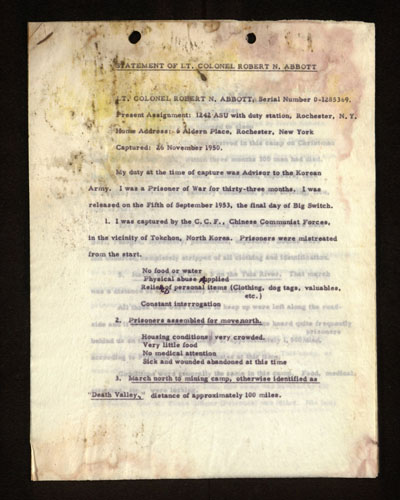
[page 1]
STATEMENT OF LT. COLONEL ROBERT N. ABBOTT
LT. COLONEL ROBERT N. ABBOTT, Serial Number 0-1285369.
Present Assignment: 1242 ASU with duty station, Rochester N.Y.
Home Address: 6 Aldern Place, Rochester, New York
Captured: 26 November 1950
My duty at the time of capture was Advisor to the Korean
Army I was a Prisoner of War for thirty-three months. I was
released on the Fifth of Septmeber 1953, the final day of Big Switch.
1. I was captured by the C.C.F., Chinese Communist Forces,
in the vicinity of Tokchon, North Korea. Prisoners were mistreated
from the start.
No food or water
Physical abuse applied
Relieved of personal items (Clothing, dog tags, valuables,
etc.)
Constant interrogation
2. Prisoners assembled for move north.
Housing conditions very crowded.
Very little food
No medical attention
Sick and wounded abandoned at this time
3. March north to mining camp, otherwise identified as
“Death Valley,” distance of approximately 100 miles.
[page 2]
Forced march, always at night
Considerable mistreatment on march
Shortage of food and water
No medical attention
Prisoners not allowed to sleep
Approximately 1,000 men arrived in this camp on Christmas
Day, 25 December 1950. Within three months 300 men had died.
Death resulted from lack of food, malnutrition, exposure, lack
of medical attention, poor sanitary conditions, poor housing, lice,
lack of fuel.
The various illnesses resulting from the above were Beri
Beri, Palegra, Dysentery, pneumonia, exposure. Bodies were
left unburied, completely stripped of all clothing and identification.
5. March north to Camp 5 on the Yula River. That march
was a distance of approximately 100 miles.
All those who were unable to keep up were left along the road-
side and it is assumed that they died. Shots were heard quite frequently
behind us on this march. At Camp 5, approximately 1,500 prisoners died
according to Prisoner of War estimates at this time.
Conditions were generally the same in this camp. Food, medical,
attention, etc., were lacking
[page 3]
6. Korean Interrogation Center, otherwise identified as
Paks Palace.
This interrogation center was controlled by North Korean
Officers. They continuously applied physical abuse in their interro-
gations. Starvation, lack of medical attention and forced labor also
prevailed in this camp. It is estimated that approximately forty
deaths can be indirectly attributed to time spent in this camp.
7. Describe own physical condition at this time
This condition was generally true of all prisoners. I
was suffering from extreme malnutrition, weighing approximately
100 pounds, compared to a normal weight of 200 pounds. I was paralyzed
as a result of Palegria and Beri Beri. I had an extreme case of
dysentery. No medical attention was made available to any
prisoners in this camp.
8. Start of Peace Talks
Returned to CCF at Camp No. 3. Conditions in this camp
were still very poor. Prisoners were dying daily. This camp, as
were all camps, unmarked.
On or about September 20th, this camp was bombed by UN
Air Force. One Air Force Officer (Prisoner) was killed. His body
[page 4]
was displayed nude in the Public Square and all prisoners and
civilians were required to view it.
9. Was moved to Camp No. 5 at Pyoktong. Placed in
hospital. Prisoners were dying as a result of dysentery, palegria,
Beri Beri, malnutrition. In this hospital prisoners were being
forced to undergo tissue operations. Those refusing were denied
further medical attention.
10. Moved to Officers Camp No. 2
In this camp officers were being exposed to a severe
indoctrination program (brain washing). These educational
periods lasted from early morning until late at night. Very
little medical attention was available. Food was very inadequate.
Prisoners were being exposed to long periods of interrogation
and failure to answer questions resulted in prolonged periods of
solitary confinement. The senior officers were continuously being
tried for crimes that they were not guilty of. These trials resulted
in long sentences of solitary confinement.
Prisoners were denied mail from home, news from the
outside world. They were required to read only Communist
literature. Red Cross packages were not available. Recreation
[page 5]
was very limited. The harassment in this camp continued up until the
signing of the Armistice. On the final day of the signing of the
Armistice, three senior officers were sentenced to one year, nine
months, and six months for violations of regulations.